Virtual Museum
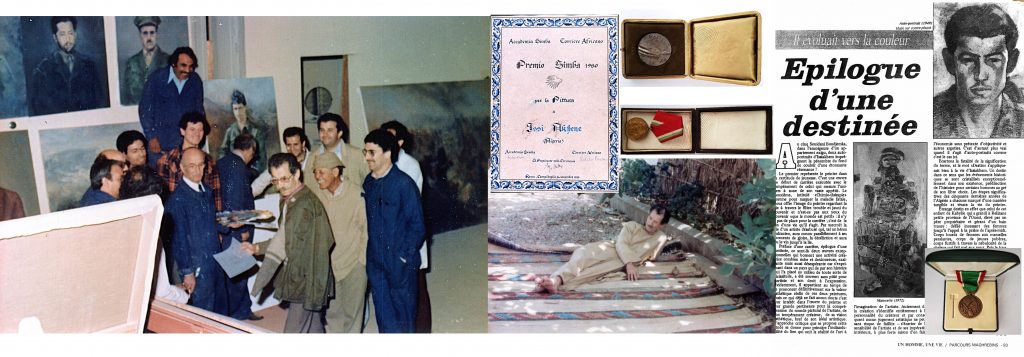
M’hamed Issiakhem
1928–1985

Welcome to the Virtual Museum of M’Hamed Issiakhem

This french audio message by M’Hamed Issiakhem, recorded during an interview with Ahmed Azeghagh, is addressed to you as guidance from the pedagogue he was, regarding how to approach artworks. He emphasizes the importance of doing so with an unencumbered gaze, free from the shadow of their creator. The artist, he says, is not there to impose or explain, but to offer the fruit of his research and his continual questioning, then step aside. It is up to each visitor to find their own truth.

Enjoy your visit*, Issiakhem Foundation (*your visit will be optimized on a tablet or desktop computer.)

Period 1949–1962 – Fine Arts Education and Activist Engagement

Female Nude – Seated Woman, 1949


Charcoal on paper, 63 × 48 cm

Study produced during M’Hamed Issiakhem’s training at the École des Beaux-Arts of Algiers.
The delicacy and sensitivity of the line reveal the painter’s early mastery as a draughtsman.

Female Nude – Standing Woman, 1949


Charcoal on paper, 63 × 48 cm

Study produced during M’Hamed Issiakhem’s training at the École des Beaux-Arts of Algiers.

Self-Portrait, 1949


Oil on canvas, 41 × 32 cm

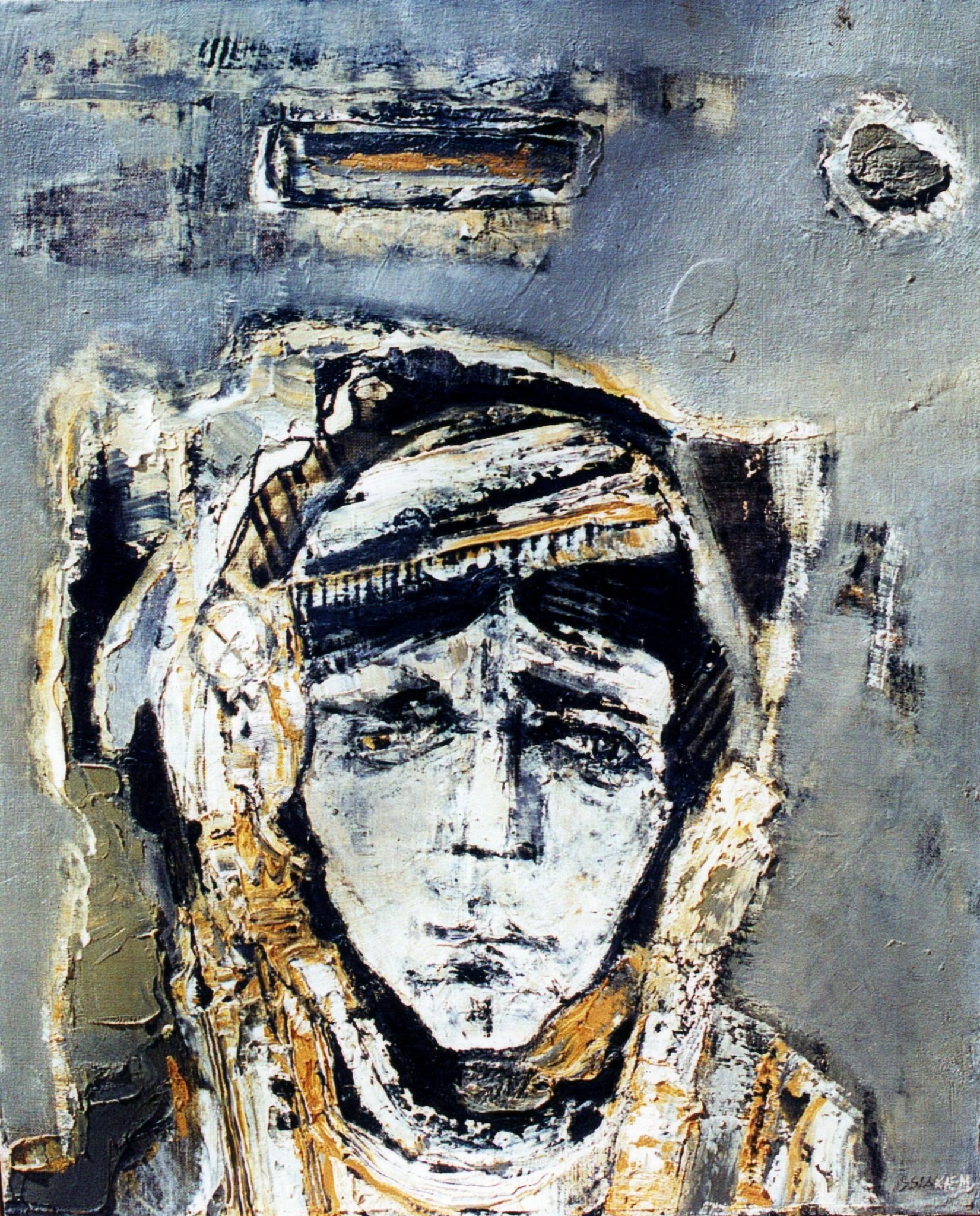
Created in 1949 while he was a student at the École des Beaux-Arts of Algiers, this first self-portrait reveals an introspective depth that would later become a defining feature of his work.
Donated to the MNBA by Mohamed Racim, attesting to the early recognition of the young artist.

The Arab House – 1950


Print No. 15

His talent for printmaking was quickly recognized, and he was invited to contribute to the collective publication
18 Engravings in Intaglio Executed by the École des Beaux-Arts of Algiers. He signed two contributions:
the opening plate, The Gate of the Stéphane Gsell Museum, as well as this engraving. The artist was not yet 22 years old.

Engraving, 1952


Pen drawing, 35 × 18 cm

Engraving exercise. A technique he would go on to master at the highest level,
both in the creation of pen-and-paint masterpieces and in the design of banknotes.

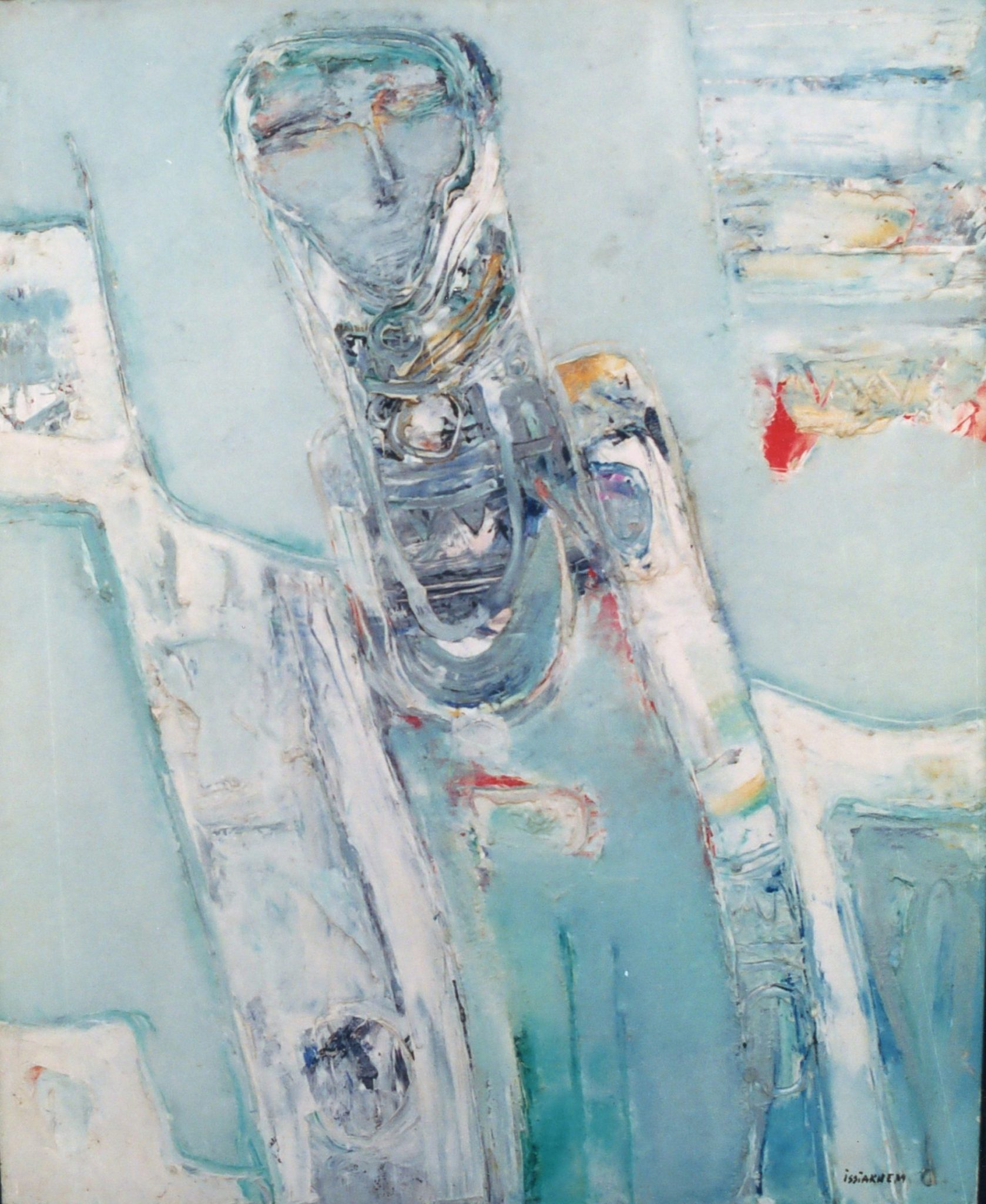
African Figures, 1957

Oil on glass, 79 × 36 cm

“It bothers me to be classified among the figurative artists, just as it would bother me to be classified among the abstract ones,”
M’Hamed Issiakhem – Révolution Africaine, 1985.
In this work, he draws upon the Berber signs of his childhood, notably the Ikufan.
Together with the Portrait of 1949, it foreshadows the visual language of M’Hamed Issiakhem:
symbolic figuration, post-Cubist inflections, and an underlying expressionist tension.

Algeria 1960


Mixed media including collage and painting

The work stands as a political and social manifesto. The press clippings, such as
“MOURIR” and “L’HUMANITÉ”, refer to the Algerian War and to the
Declaration on the Right to Insubordination of 1960.

Through the expressive gazes of its figures, the composition conveys the determination of a resolute people.

Mystic, 1960


Oil on canvas, 55 × 46 cm

Between the 1960s and 1970s, the city of Paris acquired several works by Algerian artists.
It was within this context that this work by M’Hamed Issiakhem entered its collections.
The painting reflects Cubist principles, pronounced expressionist accents driven by emotional intensity,
and an iconographic approach that places the human condition at the center of his concerns
throughout his artistic career.

The Widow, 1962


Oil on canvas

“I was far from my mother; I was no longer a burden to her. I wanted to prove to her that a disabled person could earn money.”
Révolution Africaine, May 1985.

The theme of the mother and child would permeate M’Hamed Issiakhem’s work.

Period 1962–1972 – Resolutions and Disillusions

The Martyrs, 1964


Oil on canvas, 90 × 190 cm

Presented at the UNAP exhibition, this large canvas revisits the themes of the national liberation war.
This line of work would lead, a few years later, to the masterpiece To Those Who Attempted to Cross…, shown below.
One can already note the appearance of his hand, mutilated in the explosion.

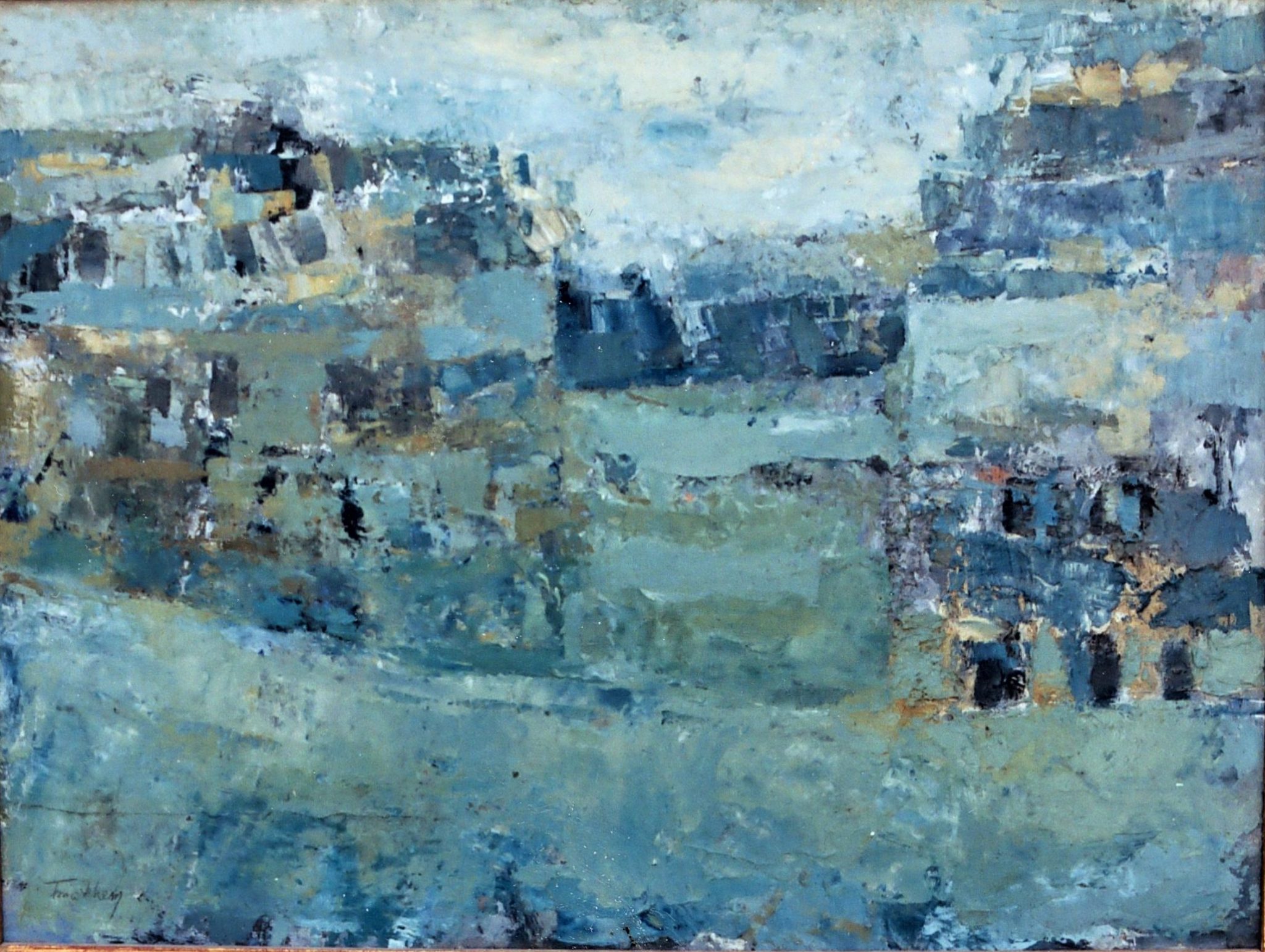
Kabyle Landscape, 1964

Oil on canvas, 41 × 55 cm

The title was rarely provided by the painter himself, making its certain association with the presumed subject difficult.
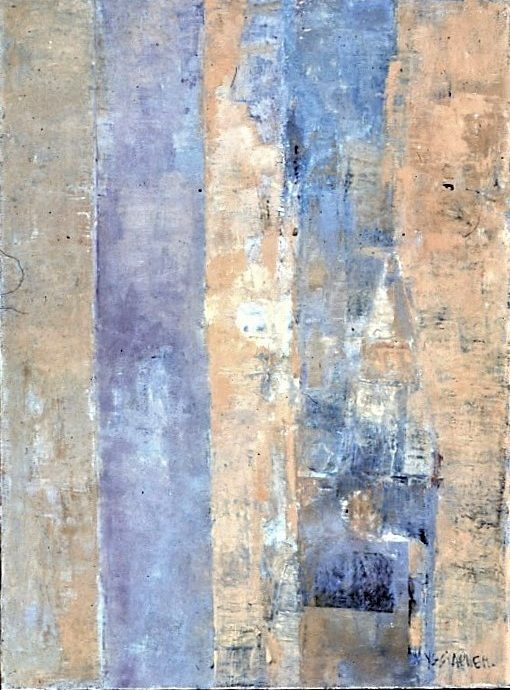
Although seemingly abstract at first glance, the work nonetheless reveals the early richness of M’Hamed Issiakhem’s palette,
an artist too often — and arbitrarily — classified among figurative painters.

Untitled, 1964


Oil on canvas, 73 × 60 cm

“For me, woman is the source. I have observed in our country that women possess qualities men do not have.
Women are more positive, more concrete, more realistic than men.”
M’Hamed Issiakhem, Révolution Africaine, 1985.

This fascination would place women at the center of the painter’s subjects.

Untitled, 1964


Oil on canvas, 54 × 73 cm

In this composition, human figures and symbols remain identifiable.
M’Hamed Issiakhem’s visual language asserts itself here.
The dramatic intensity, the vigorous handling of the material,
and the emphasis placed on emotion fully characterize his expressionist approach.

Untitled, 1964


Oil on plywood, 99 × 65 cm

“Through the garment of the « Aaroubia »(algerian women), you can discover our entire history.
First, all the elements that constitute the environment in which the human being evolves:
the earth, the sky, all the essential elements — the mineral, the vegetal, the animal.
The flower is in the garment. Even the smallest piece added to the torn garment
has its own little flower, because the flower was chosen. That is what art is.”
— M’Hamed Issiakhem, Sahraoui, RTA tribute film, 1985.

Untitled, 1966


Oil on wood, 60 × 104 cm

This composition presents stylized figures: a horizontal frieze that draws both on Cubism
and Expressionism, while absorbing the colours and light of North Africa.

Untitled, 1967


Oil on canvas, 100 × 81 cm

This 1967 painting marks a shift toward symbolic figuration,
where faces gain in expressiveness and contours become more pronounced.
This approach would dominate his depictions of the human figure.

South, 1968


Oil on plywood, 67 × 58 cm

“I have remained with the memory of my mother’s colours. … My mother was very rich in colours, very, very rich in colours.
These are the colours that come back to me. They are colours carried by a presence — my mother’s presence — that return to me.
Violent colours in the burning fields, especially in summer, in summer…”
M’Hamed Issiakhem.

Unfinished Berberia, 1968


Oil on canvas

This work is singular in more than one respect. Left unfinished, it reminds us that an artist’s creative path is never linear.

Casbah, 1969


Gouache and pen drawing on paper, 47 × 31 cm

M’Hamed Issiakhem would revisit the Berber motifs of his childhood in many of his works.
He also produced tapestries.
As with other pieces, the title of the work was assigned arbitrarily by others.

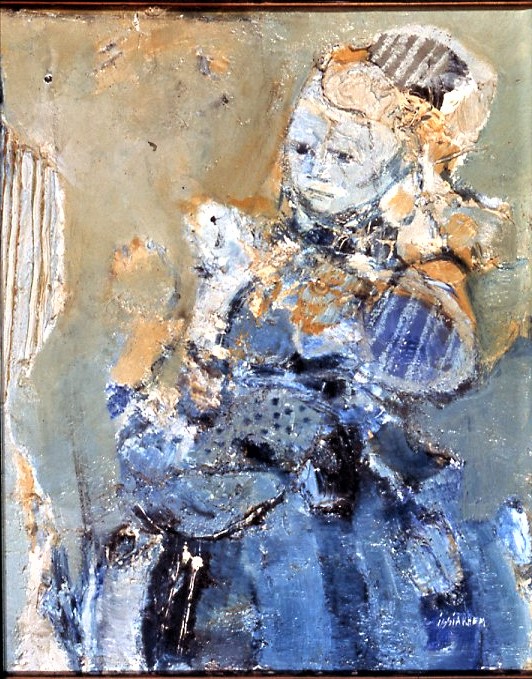
Little Girl, 1969


Oil on canvas, 55 × 46 cm

The blond hair of this young girl belongs to Katia, M’Hamed Issiakhem’s eldest daughter.

Chaouia, 1969


Gouache on paper, 66.5 × 51.5 cm

This gouache is a major work by the painter. It marks the culmination of M’Hamed Issiakhem’s style:
it condenses the entirety of his visual research. Berber motifs, integrated as a living memory, structure
a dense composition in which each element finds its necessity, within an iconography of the mask and the icon.

In Memory of…, 1969


Oil on canvas, 162 × 130 cm

Created and exhibited during the 1969 Pan-African Festival, this work—produced in pain—
is unquestionably one of M’Hamed Issiakhem’s masterpieces.
Donated to the MAMA by Zoulikha Benzine, it evokes with great force the War of Liberation
and the horrors of the Morice and Challe lines.

Black Sun, 1969


Oil on canvas, 59 × 48 cm

The composition highlights a stylized figuration in which expressionist intensity is unmistakably present.
The figures, often hieratic and frontal, reflect a desire to universalize the subject beyond the individual.

Artist’s Family, 1969


Oil on canvas, 192 × 129 cm

The title was rarely provided by the painter himself, making its certain association with the presumed subject difficult.
This archetypal work symbolizes the painter’s pursuit: representing the human condition of his people.

The Passage, 1969


Oil on canvas, 80 × 60 cm

Look closely: a profile emerges from this resolutely abstract work.

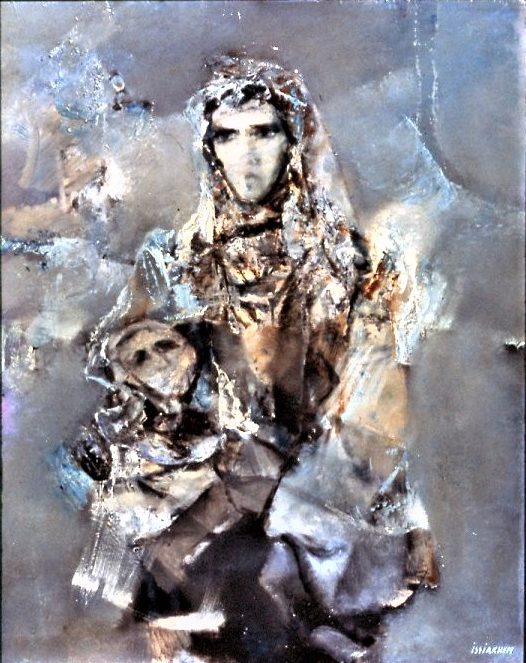
Mother and Child, 1970


Oil on canvas, 150 × 100 cm

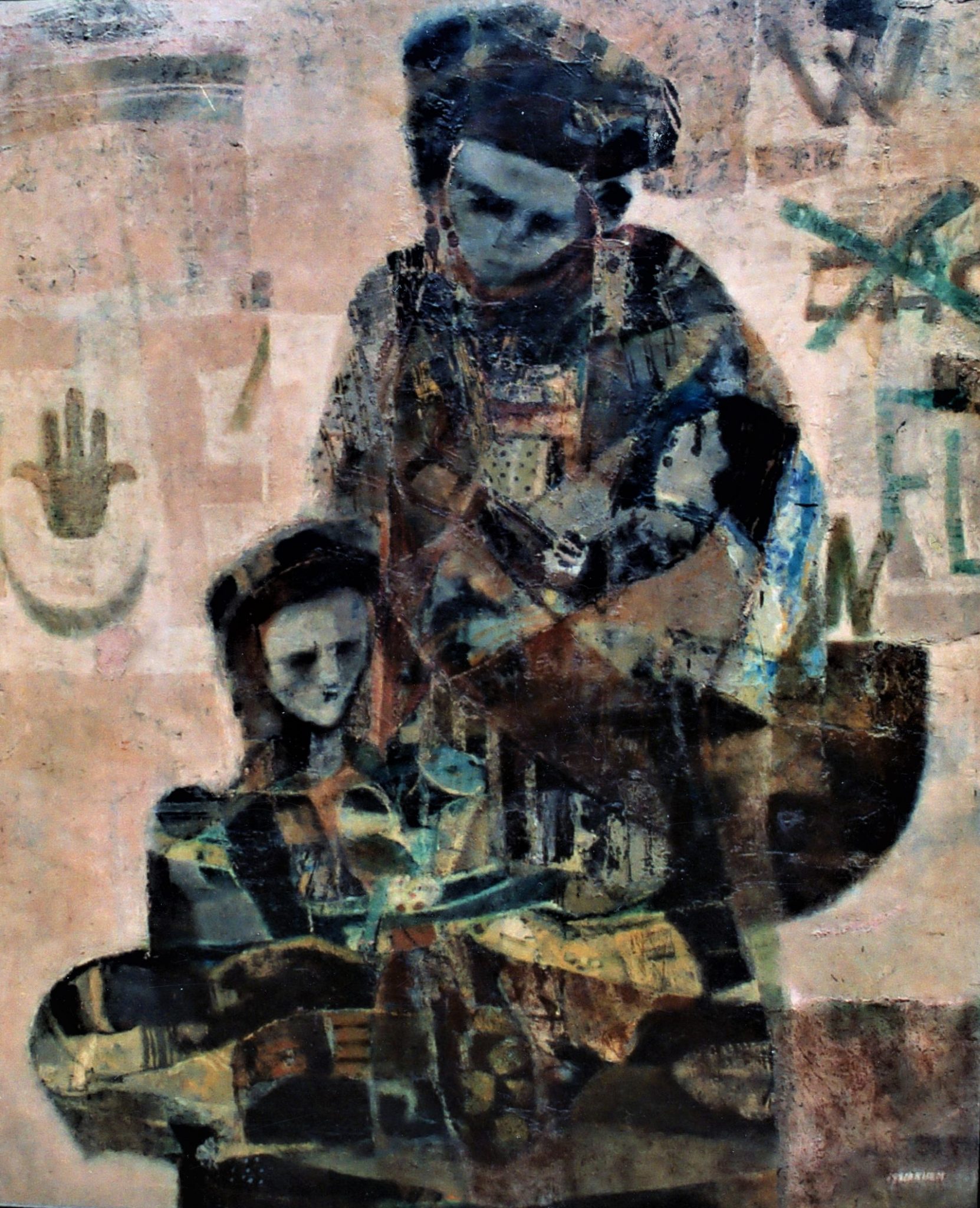
This remarkable work revisits the archetypal theme of mother and child,
a recurring motif in M’Hamed Issiakhem’s œuvre, approached here with a particularly
significant degree of refinement and artistic maturity.

The Widow, 1970

Oil on canvas, 100 × 65 cm

“It is inside this static mass that everything moves…
It does not move in the same way from one person to another…
The figure itself is static — everything moves within it.
These are atoms that are set, enclosed, cloistered, imprisoned.”
M’Hamed Issiakhem — interview with Ahmed Azzegagh, 1985.

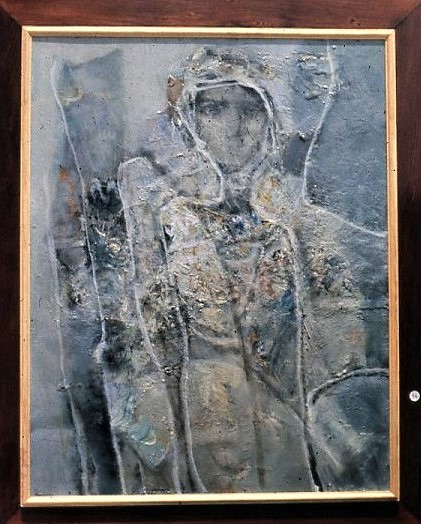
The Bride, 1971

Oil on canvas, 105 × 85 cm

The bride is not depicted here in a realistic manner but as an archetypal figure:
a universal allegory of passage, union, and transformation.
The abstraction of forms and the monumentality of the figure allow the work to transcend
individual identity and address broader reflections on identity, the human condition,
and foundational rituals.

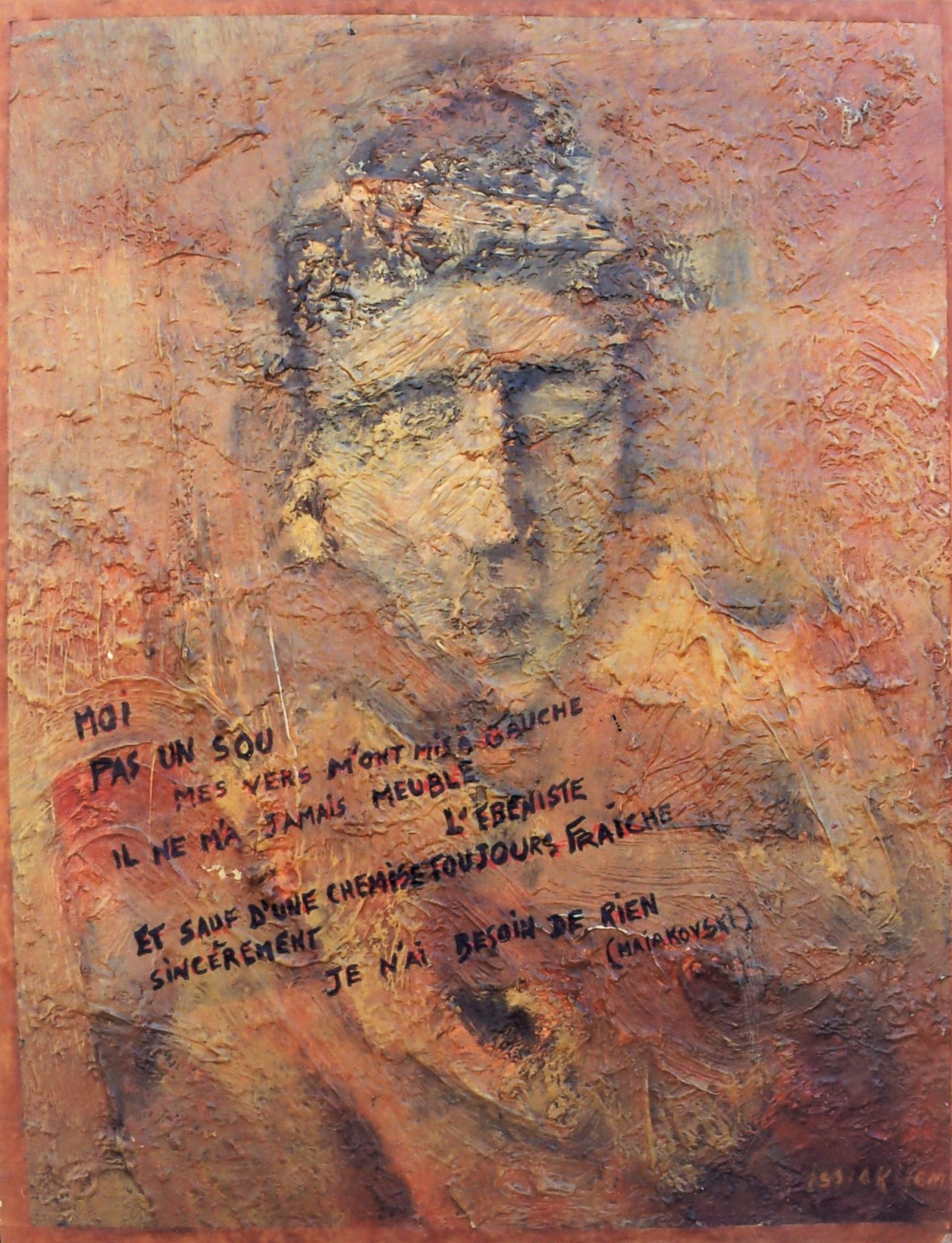
Mayakovsky, 1971

Oil on canvas, 65 × 51 cm

“My verses
have not brought me a single rouble,
cabinetmakers
have not delivered furniture to my door.
And, apart from
a freshly laundered shirt,
I confess in all conscience,
I need nothing.”
At the Top of My Voice – Mayakovsky, 1930.

The poet addresses future generations as “comrades,” recounting his revolutionary life, which rejected worldly art in favour of combative poetry.
His verses, which he likens to weapons, are meant to serve the class struggle rather than ornamentation.
This is also how M’Hamed Issiakhem conceived his art.

Virginity, 1971


Oil on canvas, 100 × 80 cm

It is never insignificant to see the only hand the artist retained — a hand mutilated by the grenade explosion.
The brushstroke imprints the blood that seems to tear it apart in the flow of paint.
All of this indicates that this woman is not just anyone.


Anguish, 1971–1972


Oil on plywood, 91 × 41 cm

It is often futile to seek meaning in the title, particularly since the artist rarely titled his works.
It is equally illusory to attempt to assign a fixed interpretation to what stems above all from a vital impulse:
the impulse to paint.

Period 1972–1979 – Maturity and Achievement

Untitled, estimated 1972

Oil on canvas

Let us evoke the style of M’Hamed Issiakhem: a fragmented construction rooted in post-Cubist approaches,
an expressive intensity close to Expressionism, a hieratic frontality recalling icon painting,
and a stylisation of the face that resonates with certain African traditions.

Untitled, 1972

Oil on canvas

Another illustration of the characteristic style of the 1970s.

Study on Palette, 1972

Oil on canvas, 61 × 50 cm

“You cannot imagine the number of acrobatics I had to perform to question myself, to correct myself,
to turn back upon myself — to demolish everything in order to start again better…”
M’Hamed Issiakhem

The Surgeon, 1972

Oil on canvas, 65 × 50 cm

M’Hamed Issiakhem would never forget the surgeon to whom he owed his life.


Reading, 1972


Oil on plywood, 93 × 74 cm

Every painter has their Mona Lisa — perhaps Reading is M’Hamed Issiakhem’s.
The identity of the reader remains unknown, although several hypotheses exist.

Motherhood, 1972

Oil on plywood, 240 × 112 cm

This work could have been titled Beggar Woman. However, as previously mentioned, the title of an artwork was, in many cases, not given by the artist himself.

Woman in Meditation, 1972

Oil on canvas, 60 × 73 cm

Another illustration of M’Hamed Issiakhem’s style, with its fragmented construction rooted in post-Cubist approaches,
an expressive intensity close to Expressionism, a hieratic frontality recalling icon painting,
and a stylisation of the face that echoes certain African traditions.
Destitute Woman, 1972 Oil on chipboard, 165 × 100 cm

The Beggar Woman, 1972

Oil on plywood, 152 × 125 cm

“At the centre of all my works, peasants, paupers, and the maimed often appear.
It is through the rural world that I discover my painting, my sensibility…”
M’Hamed Issiakhem

Motherhood, 1972

Oil on canvas, 113 × 72 cm

“I have observed that in our country, women possess qualities that men are deprived of.”
M’Hamed Issiakhem

Woman’s Gaze, 1972

Oil on wood, 97 × 33 cm

“I am very faithful to the condition of women, who experience their womanhood intensely…
Woman… But it is a very abstract subject!
It is a very abstract subject that defines me above all from a plastic point of view…
What is woman to me? She is the source.”
M’Hamed Issiakhem

Woman with Child, undated

Oil on canvas, 115 × 89 cm

“Whether one expresses oneself through abstraction, figuration, or otherwise, the essential for an artist is to offer the public a work that acts like a boomerang.”
M’Hamed Issiakhem
Marriage of Widowers, 1972 Oil on canvas, 72 × 59 cm

Kanoun, 1973

Oil on canvas, 162 × 130 cm

Man in the Kachabia, 1973

Oil on canvas, 100 × 66 cm

.

The Disabled Man, 1973

Oil on wood, 55 × 45 cm

“Painting hurts me. When I paint, I suffer. Perhaps it is a form of masochism.
I am a painter — or consider myself as such — but for me it is always surrounded by doubt.
Because I do not know what it truly means, to be a painter.”
M’Hamed Issiakhem

Chaouia, 1973

64 × 53 cm

“I am too sensitive to the human condition to suddenly turn my back on this figure.
This endlessly repeated figure — for me, it is the human being, Ben Adam.
He stands at the centre of my work.”
M’Hamed Issiakhem

Woman and Children, 1974
Oil on wood, 98 × 98 cm

“If the painter does not live and express the drama of his society, he is not an artist.”
M’Hamed Issiakhem

Motherhood II, 1974

MNBA — Oil on canvas, 100 × 80 cm

.

The Resurrection of the Phoenix, 1975

Oil on wood panel

This work could have been titled In Memory of… II (1969), presented earlier in the exhibition,
as it revisits the same theme of armed struggle and the victims of the Morice and Challe lines.

Self-Portrait II, 1976

Oil on chipboard, 92.5 × 45.5 cm

This is the second of the three known self-portraits he produced. It was dedicated to Zoulikha and Djaffar Inal.

.

Key to Happiness, 1976

Oil on canvas, 31 × 200 cm

The Refugees, 1976

Oil on canvas, 100 × 150 cm

« I have always been sensitive to all those who struggle to survive under difficult conditions. » — M’Hamed Issiakhem

My Tribe Algeria, 1976

Oil on canvas, 37 × 210 cm

X, 1976 Oil on canvas, 120 × 80 cm
History Reclaimed, 1976 Oil on canvas, 74 × 60 cm
“Go slightly up the A‘roubia and you will see. As you follow it, you will discover, through the dress of the A‘roubia, our entire history. All the elements that form the environment in which the human being evolves: the earth, the sky, all the essential elements… The flower is in the dress. Each patch, even the smallest one added to the torn dress, carries its own flower, because the piece was chosen. That is what art is.” — M’Hamed Issiakhem

.

Sketch, 1977

Indian ink and gouache, 37 × 24.5 cm

Sketch, 1977

Gouache on paper, 8.5 × 23 cm

Sketch, 1977

Gouache on paper, 28.5 × 23 cm

To Sid Ahmed Inal and Abdelhamid Benzine, 1976

Oil on canvas, 110 × 200 cm

Past, Present and Future Oil on canvas, 230 × 140 cm
This work has a particular history: it was commissioned by a friend for the decoration of a specific place.
X, 1977 Oil on canvas, 81 × 60 cm
This work has a particular history: it was commissioned by a friend for the decoration of a specific place.

.

Zoulikha, 1977
This portrait depicts Zoulikha Benzine, a heroine of the War of Independence and a member of the Saint-Eugène Fidaïyin network. She was imprisoned before joining the armed resistance in the maquis.
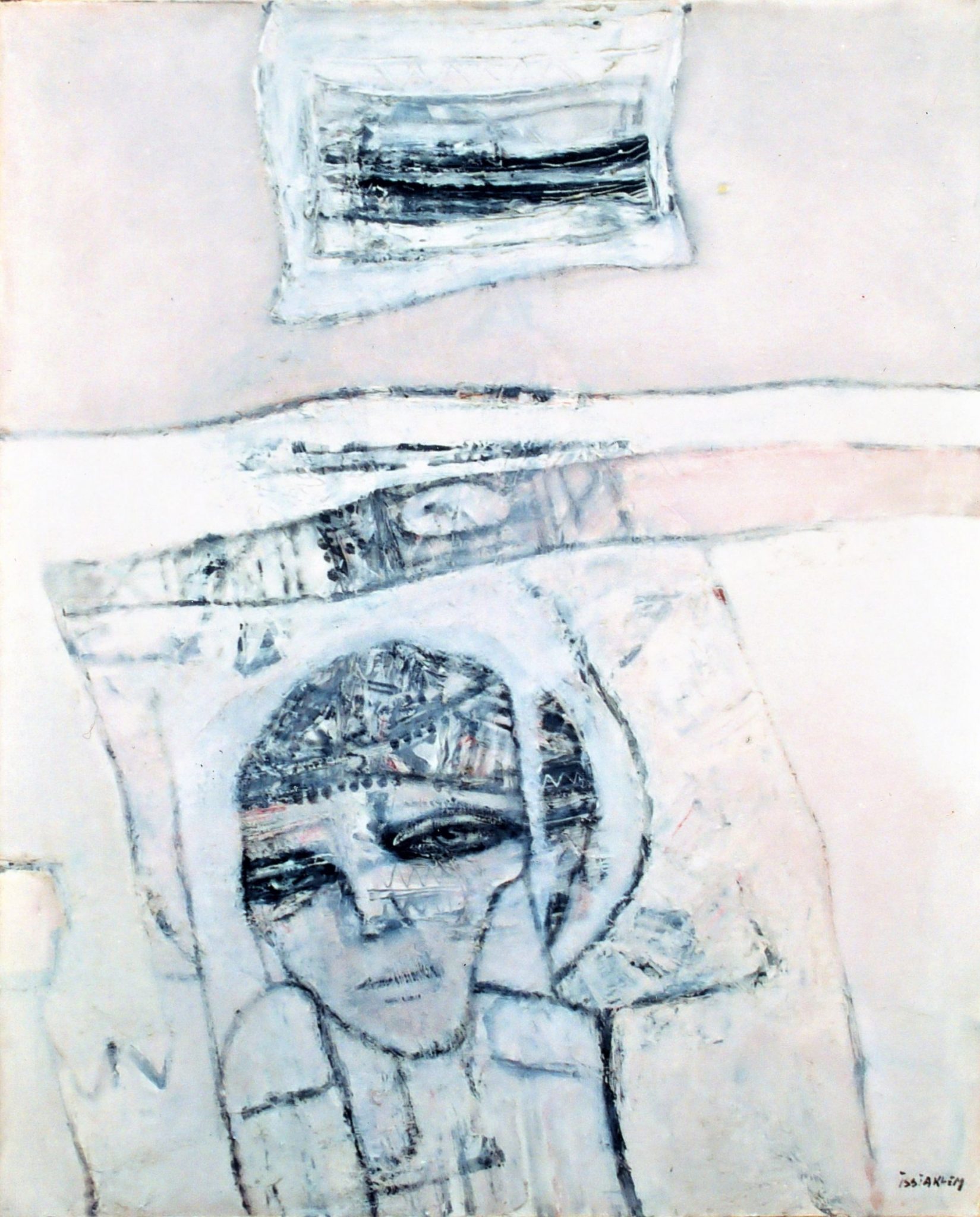
Old Kabyle Woman, 1977–1978 Oil on plywood, 100 × 77 cm
X, 1977–1978 Oil on wood, 235 × 110 cm

The Chaouias, 1978

MAMA – Oil on canvas, 200 × 100 cm

“At the center of all my works, peasants, outcasts and the maimed often appear.
It is through the rural world that I discover my painting, my sensibility…” — M’Hamed Issiakhem
Woman’s Pain, 1979
“I have remained faithful to my figures; my figures are Algerian; they have not drifted into fantasy — they have endured. My figures have all been tortured; they have suffered not only from the war, but from this vast history, a millennia-old history…” — M’Hamed Issiakhem

Mother I, 1979

Oil on canvas

“Woman is more positive, more concrete, more realistic than man. She is more objective, more logical, more sound.” — M’Hamed Issiakhem

Period 1980 to 1985 – Epilogue of a Destiny

Sketch, 1980


Gouache on paper, 42 × 29.5 cm

Overprint on Kabyle Chest Motif, 1980


Gouache on paper, 85 × 50 cm

This work overlays the motifs of a fragment of a Kabyle chest that the artist owned.

X, 1980

Oil on canvas, 162 × 130 cm

“I am meant to call them to order, to remind them that they have gone through painful and difficult times—times they tend to forget.” — M’Hamed Issiakhem
X, 1980 Oil on canvas, 100 × 81 cm
X, 1981 Gouache

El Aurassi Exhibition – Untitled, 1981

Oil on canvas

“I no longer realise that I am missing an arm. It is only when someone reminds me of it that I think about it. It may amuse some people. I noticed that, in front of my paintings, some tended to lean or tilt their heads to look more closely. I concluded that perhaps there was something asymmetrical in me.” — M’Hamed Issiakhem
El Aurassi Exhibition – Untitled, 1981 Oil on canvas

El Aurassi Exhibition – Untitled, 1980

Oil on canvas

Portrait, 1981

India ink and gouache, 33 × 18.5 cm

This pen drawing, executed in the manner of an engraving, is enhanced with gouache. This technique, combining the finesse of line with the subtlety of gouache, is one of the most remarkable expressions of M’Hamed Issiakhem’s art. Further examples will follow.

Khadidja, 1981

Gouache on paper, 40 × 30 cm

M’Hamed Issiakhem produced numerous portraits. This one is inspired by the Berber singer Khadidja Hamsi.

Hadj El Anka, 1982

Oil on canvas

This work is a portrait of the Chaabi singer Hadj El Anka. It was painted in the artist’s home, as the two artists were neighbours.

Anxiety, 1982

Mixed media: ink and gouache, 40 × 30 cm

This drawing is executed in mixed media, combining pen work in the manner of an engraving with gouache. This technique, which unites the precision of line with the tonal richness of gouache, represents one of the most distinctive facets of M’Hamed Issiakhem’s art.

Pregnant Woman, 1982

Oil on canvas, 100 × 81 cm

The Blind, 1982

MNBA – Oil on canvas, 162 × 129 cm

The inscription at the lower right reads:
“… We who live in the past. We, the strongest of multitudes. Our numbers grow ceaselessly. And we await reinforcement …”
Kateb Yacine – *Chorus of the Ancestors*

Berber Woman, 1982

Oil on canvas, 160 × 130 cm

“Whether one expresses oneself in an abstract, figurative or any other manner, what matters for an artist is to offer the public a work that acts like a boomerang.”
M’Hamed ISSIAKHEM

Cardinal Duval, 1982

Oil on canvas, 114 × 75 cm

Among the outspoken critics of the colonial establishment and defenders of Muslims stood a significant figure: Cardinal Duval, Archbishop of Algiers from 1954 to 1988.
Through the mediation of Professor Asselah, a meeting was arranged between M’Hamed Issiakhem and the Cardinal.
From this encounter emerged one of the painter’s most emblematic works.

Feyrouz, 1982

Gouache on paper, 65 × 50 cm

This work is dedicated to Professor Galli, a neurosurgeon who practiced in Algeria.

Woman and Child, 1982

Oil on canvas, 98 × 81 cm

Oceani-Nox, 1982

Oil on plywood, 73 × 60 cm

Transparency, 1982

Oil on canvas, 66 × 80 cm

Woman and Child, 1982

Oil on canvas, 110 × 81 cm

« This character, this figure that I depict endlessly… in theory, I could do without it.
Yes, I could do without it. But I am too sensitive to the human condition to suddenly turn my back on this figure. » — M’Hamed Issiakhem
Giuliana’s Eyes (Aurès), 1982 Oil on canvas, 100 × 81 cm

Woman, 1983

India ink, 55 × 40 cm

M’hamed Issiakhem reaches the height of his mastery in this work. Connoisseurs will appreciate the virtuosity of the pen-and-ink execution.

Man, 1983

India ink, 55 × 40 cm

The Berber Woman, 1983

Oil on canvas

“From where do you draw
The strength to survive
And never falter?
Among us, barbarians,
You may be caged,
Yet never have your red eyes
Overflowed with fury.
Heavy-hearted,
Thinking of the grandiose crimes
Of your kin,
You have no sense of death.

Close to the old shark
Haunted by its victims,
Near the ancestor ringed with islands,
Lies the secret of being—
Atrocious,
Unexpected…”
Kateb Yacine.

Blue, 1984

Oil on canvas, 106 × 81 cm

The Palestinian Woman, 1984 Oil on canvas
The Wall, 1984 Oil on canvas, 115 × 81 cm
Oblique, 1985 MNBA – Oil on canvas, 98 × 80 cm

Woman at the Table, 1985

Oil on canvas, 116 × 80 cm

Woman on Poem, 1985 Oil on canvas, 102 × 82 cm

Man, 1985

Indian ink

Waiting, 1985

MNBA — Oil on canvas, 98 × 81 cm

Depression, 1985 MNBA — Oil on canvas, 80 × 100 cm
Little Girl II, 1985 Oil on canvas, 64 × 54 cm

Red, 1985

Oil on canvas, 72 × 91 cm

M.S. Ziad, 1985 MNBA – Oil on canvas, 100 × 82 cm
Mohand Saïd Ziad was a journalist and a close friend of M’Hamed Issiakhem.
Telethorax, 1980 Oil on X-ray plate, 86.5 × 73.5 cm

Pregnancy, 1986

MNBA – Oil on canvas, 92 × 72 cm

Self-Portrait III, 1985


Oil on plywood, 84 × 58 cm

This final self-portrait is that of a dying man aware of his fate. The work marks the culmination of a life devoted entirely to art and to his people.

End of the visit

“One day, while I was at his home, M’Hamed led me to the corner where he
worked and showed me a canvas on which a sketched woman was waiting to emerge
from the mist that veiled her and to acquire a clearer structure. M’Hamed
picked up a brush, dipped it into black paint, and moved toward the woman.
‘Look,’ he said to me, ‘I’m going to make her cry.’” — Tahar Djaout, may he rest in peace